Showing posts with label expat. Show all posts

Dec 15, 2014

Celebrating Christmas Abroad

Most people associate the holidays with visiting family and/or going "home." When you live abroad and this isn't always possible, however, you learn to appreciate different Christmas traditions. Most of my students cringed when I told them how I celebrated 25th December in Oz a few years ago. Christmas in the summertime? How outlandish! Looking back, I have nothing but fond memories of how I've spent Christmas over the years.
http://shelleypascual.com

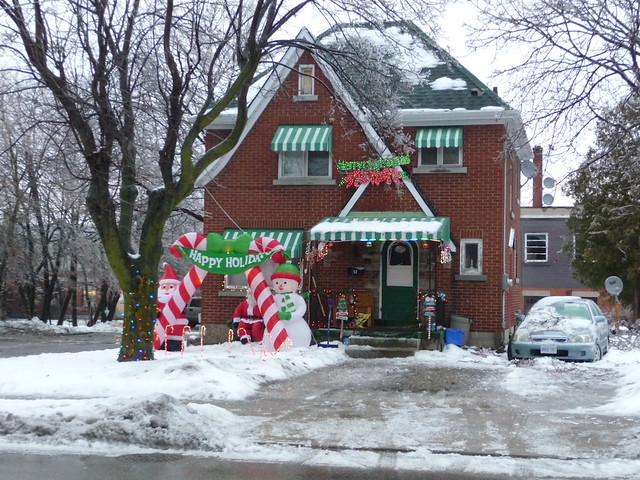
Christmas in Canada

There's this stereotype that us North Americans all celebrate Christmas on 25th December, and I can't speak on behalf of the Canadians that do, because I grew up having a feast in the evening of the 24th with my big fat Filipino family. Uncle Rod had the honours of handing out all the gifts at midnight, and when my cousins and I were kids he even dressed up as Santa Claus!

For my sister and I, Christmas Day wasn't as big a deal as Christmas Eve. Nevertheless, we loved waking up and running down the stairs to find presents from Santa (aka our parents) under the tree. They also put wee presents in our stockings hanging by the fireplace. When I was much younger I left out cookies and milk for Santa, which he obediently ate haha.

It almost always snowed at Christmastime in my childhood, though nowadays white Christmases in Toronto are hit or miss. The strongest memory I have of Christmas actually doesn't involve presents, but instead, music. My dad used to blast the Jackson 5 Christmas album as early as November, much to my dismay. The only other album I know all the lyrics to is Mariah Carey's 1994 Merry Christmas album.

http://lump.com.au

Christmas in Australia

Truth be told, the main difference between Christmas in Canada and Christmas in Australia is the climate. I was living in Melbourne at the time, and all the shops in the city were decorated with festive lights, adorned in wintery motifs. The city was dotted with artificial Christmas trees, which was appalling because it was 25-30°C at the time! Link to my old blog post [2010] Christmas in Melbourne here.

Sure, Christmas in Oz is a bit tacky, but trust me, everyone back home freezing in -10°C weather is secretly jealous that you get to bbq on the beach in shorts and a t-shirt (a typical Christmas tradition). Surrounded by fellow backpackers, I, too, had a bbq not far from the beach (St. Kilda Beach) back in Christmas 2010. It remains one of the most memorable Christmases I've ever had, not just because it was summertime, but because although it was my first Christmas away from home, I still felt "at home."
http://shelleypascual.com

Christmas in Germany

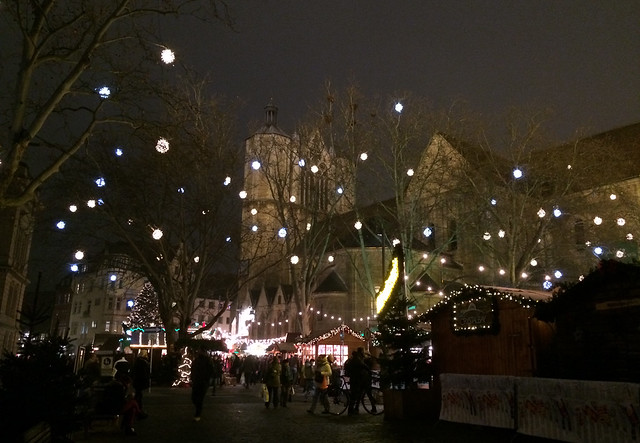
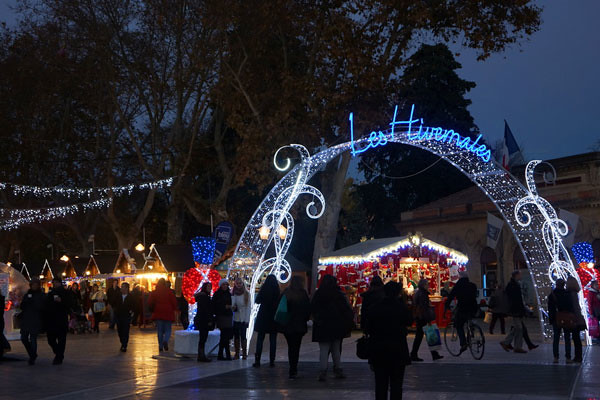
Everybody knows that the best thing about Christmas in Germany are the Christmas Markets. Steeped in tradition that goes back hundreds of years, you couldn't even begin to compare these markets with the ones that have been popping up in North America over the past few years. The Toronto Christmas Market, for example, lacks a certain charm, I find. Not hating, just saying.

The tradition of Nikolaus is another thing I love about Christmas in Germany. You're supposed to clean your boot the evening before he comes and leave it just outside your front door. On 6th December, Nikolaus fills your boot with treats such as chocolates, mandarin oranges and walnuts - but only if you've been a good girl or boy. I know this because Nikolaus visited me for the first time back in 2012!

Yet another tradition I've only seen at Christmastime in Germany is this Weihnachtsplätzchen baking bonanza. Many people dedicate an entire weekend to making Christmas cookies that are meant to last their family and friends at least a few months. Sadly, Germans don't make or eat cookies any other time of year really. I guess after stuffing your face silly with these buttery treats all throughout December, you'd definitely be sick of 'em.

NB: In Germany, Christmas Eve is referred to as the "Holy Night," Christmas Day is called the "1st Christmas Day," and Boxing Day is called the "2nd Christmas Day." Also, from 27th December up until New Year's Eve, the malls are packed with shoppers returning gifts, only it isn't called Boxing Week.
http://eatseedoblog.com

Christmas in __________

The idea for this blog post arose from the current dilemma we have of not knowing what to do this Christmas. The bf's parents are currently in Florida and plan to spend Christmas there, my family's in Canada, and without anyone to celebrate the holidays with here in Germany, I think it only makes sense to celebrate it abroad.

Admittedly, I'm excited beyond words! I love the thought of seeing something new and celebrating Christmas in a completely different country! What I've learned is that you truly can feel "at home" wherever you are for Christmas, you just gotta have an open mind. It may take me a lifetime but I hope to add more and more countries to this list and experience what Christmas is like all around the world.

Aug 2, 2014

The Top 10 Mistakes Germans Make in English

After 2 1/2 years of teaching English in Germany, I’ve developed a good understanding as to why native German speakers make the mistakes they do when speaking English. Like any language learner naturally does, they tend to think in their native language first. The trick, however, is to do the exact opposite. This is because unfortunately, not all words and expressions can be directly translated from German into English. Tipp: By making a conscious effort to think in the target language prior to speaking it, one-to-one translations can be avoided.

The following is a list I’ve compiled of the top 10 mistakes that Germans make in English due to the characteristics of their native language, be it a grammar, sentence structure or pronunciation matter. By thoroughly understanding the reasons why a German speaker makes the following mistakes, the student may focus on avoiding them and the teacher is able to make well-timed corrections accordingly.

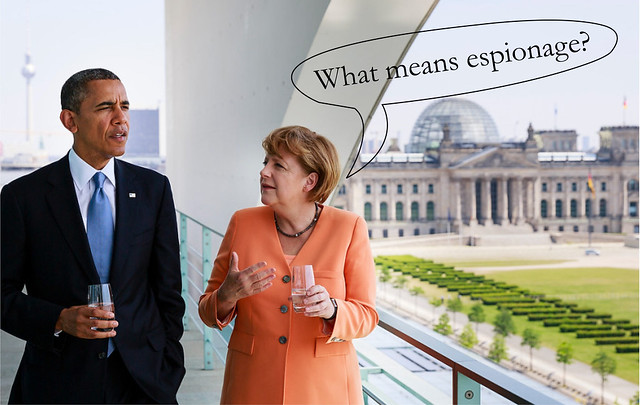
Poor Angie! She didn't actually ask this question but she's the butt of our joke because 1. she's German and 2. everyone knows her.

10. By / until

In German, bis is used to express either by or until. So for example a typical sentence I often hear is, "My boss told me to finish this task until tomorrow." No. BY tomorrow. I tell my students to remember that by means "not later than" and until answers the question "How long...?" It's just one of those concepts one learns best by doing. In the language-learning world, this means speaking (lots of it).

9. Adjectives and Adverbs

Adverbs don't exist in German. Verbs can simply be described with adjectives. If one can fly direkt to Japan and one can sing perfekt, why bother with this -ly business? Even the most advanced English learners struggle with adverbs and I presume because it's so hard to remember to tack on that -ly where appropriate, particularly when dealing with complex words like precipitately or thwartedly.

8. What means ________?

You get this question every few lessons. But beware! Get used to hearing it and sooner or later you'll start saying it yourself. In German, Was heißt ________? is used to ask someone what a word means. German speakers forget, however, that they need the helping verb do in order to form a question in English. What means 'awkward?' ✓What DOES 'awkward' mean?

7. Fahren (to drive)

Germans, as efficient and practical as they are, need only one verb, fahren, to describe a million types of movement. In German, you can drive not only a car but also a boat, a train, a bike, a skateboard, a pair of skiis - you name it. Student: "I'm driving to Dresden next week." Me: "How long does it take to get there from Braunschweig?" Student: "If my train is punctual, 3 hours." *facepalm*

6. Since / for

Here's where it gets sort of tricky. In German, one could say Ich lebe in Kanada seit 8 Jahren. One-to-one translation: I live in Canada since 8 years. Correct translation: I've lived in Canada for 8 years. Now do you get why it's so confusing for German speakers? To make matters worse, one could also say Vor fünf Jahren war ich in Australien. One-to-one translation: For five years was I in Australia. Correct translation: I was in Australia five years ago. Ago = vor and for = seit.

5. Do / make

Hey, all you English teachers out there teaching German speakers! Don't deny it. When you first heard a student say "I'm going to make party this weekend," you chuckled out loud. You had to wipe that smirk off your face when another student said they "made a BBQ" last week, didn't you? As long as you correct them every time they do a mistake, I guess you're forgiven.

4. "in the near from"

This particular mistake had to battle it out with 2nd and 3rd place because it's a phrase I hear not once, not twice, but five times a day. In German, in der nähe von is an expression commonly used to describe how close a place is to another place. That's why German speakers cannot shake the habit of directly translating and saying something like "I live in the near from Berlin." Grr.

3. "We see us..."

Every time the lesson comes to an end and I'm saying bye to my students, someone blurts this out. Someone'll say, "We see us next week!" nanoseconds before I slyly sneak in an "each other" and give them a look that says you should know this by now. In German, wir and uns are allowed in the same sentence. In English, we and us are like oil and water; in the same sentence, they repel each other.

2. Person / people

I feel like English teachers in German elementary schools weren't/aren't doing their jobs properly because this is the one mistake Germans have ingrained in them that for the life of me cannot be undone. 1 = person. 1+ = people. The word persons may occasionally be seen on signs in elevators (e.g. Max 9 Persons) but it is not used in everyday spoken English. Germans likely think that since Personen is plural in German, persons must be the correct translation. But what about the word Leute?

1. Clo-thes

Forget squirrel or Porsche or WiFi. Clothes is the #1 English word that German speakers mispronounce. My theory is this: in German, every letter is pronounced the way it looks. Silent letters don't exist. What you see is what you get. This could be why Germans pronounce clothes as two syllables instead of one. The bf has another theory. He says Germans think that cloth is the singular form of clothes, hence the need to create a second syllable and say clo-thes. Beats me.

Jul 29, 2014

Almost German / Not Quite German

In light of Germany winning the World Cup earlier this month, a question came up that I couldn't help but ponder. The big win left me questioning how German I've really become, in addition to now being a lover of football. Living in Germany has undeniably changed certain aspects about myself, some I hadn't even realized until I gave it a good think.

5 Signs That I'm Almost German

Untitled

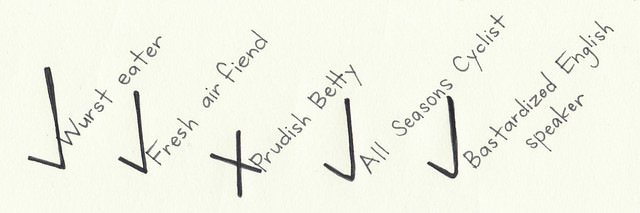
  1. I’m not particularly proud of admitting this, but, I eat Wurst almost every day. Now I know what you’re thinking and no, I don’t each sausages every day. But Wurst is also the name given to sliced meat and my lunch almost always consists of a sandwich containing Käse, Gurken, Tomaten and Wurst. Hey, at least I’m not a slave to canteen food like all of my students are. The canteen at the company where I work, by the way, serves Currywurst every day.

  2. I value ventilation like I’ve never valued it before. When in doubt, open up a window. You’ll automatically feel better. Not only does it remove the lingering smell of cheap cologne worn by businessmen in the office, it also helps to remove the feeling of stuffiness in your flat. I know this because I learned it from the Germans, a people obsessed with ventilation and who throw open their windows (albeit briefly) even in the wintertime!

  3. I’ve thrown all notions of prudishness out the window. Let’s face it: North Americans are prude. Period. Especially in the eyes of Germans, who are comfortable with nudity and actually open about sex. I feel like I grew up in a completely opposite society and culture, and almost feel liberated now that I live in Germany. Case in point: in the change rooms at my gym, women of all shapes and sizes change and shower with brazen confidence. They don’t bother trying to cover themselves up with towels or what have you. I’ve even seen women have full-on conversations with each other in the nude!

  4. I ride my bike in spring, summer, autumn and oh yes, even in winter. Expertly too. Nobody thinks I’m crazy for biking in rain or snow because everyone does it. The Germans say Es gibt kein schlechtes Wetter, nur falsche Kleidung. In other words, there’s no such thing as bad weather, but rather, inappropriate clothing. While I prefer to wear rain pants, a rain jacket and waterproof shoes, it’s typical to see people donning a poncho or holding an umbrella while riding in the rain.

  5. When Skyping or FTing with friends and family back home, I have to resist the urge to start off by saying naaaaaa and inserting German words such as doch or egal throughout the conversation, for they’d likely respond with a clueless ‘huh?’ The thing is, there are so many German words that I wish we could adopt in English. The reason why I admittedly enjoy peppering my English with German words is simply because these words fit so well in context yet do not have direct English translations or, when translated, don't express what I'm trying to say as fittingly.

So there you have it. I'm probably, say, 25% German? Am I therefore a mere 75% Canadian? However which way you want to break it down, there are definitely qualities about me that aren't German-like.

10 Signs That I'm Not Quite German

Untitled

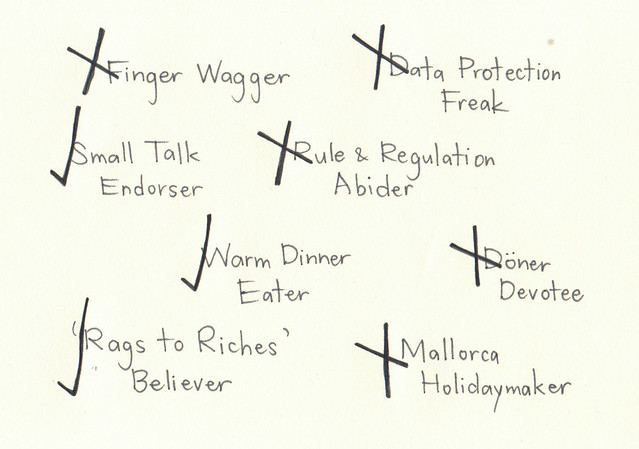
  1. I can’t say I love making small talk but I definitely don’t mind it when the person I’m talking to gives me something to work with. Conversely, Germans hate it. What we believe is essential for networking and for building good relationships, they think is a waste of time. The problem is Germans think that when English speakers make small talk, it’s superficial. It’s hard for them to comprehend that asking someone “How are you?” isn’t necessarily meant to inquire about one’s life in detail. This is because in German, Wie geht’s Dir? is indeed meant to sincerely inquire about one’s (oftentimes personal) life and normally only asked by close friends and family.

  2. I don’t care if people choose not to follow rules and regulations and I most definitely will not wag my finger nor scream at a jay-walker. Germany is a land of rule and regulation abiders, which is fine by me. But we do live in a free society, no? If someone chooses to jay-walk, that’s his or her decision and I’m not wasting energy or my emotions on denouncing that person.

  3. I’ll never learn to be as direct as Germans are. Countless times I’ve experienced (mostly old) people scream at me for things like biking too close to the sidewalk and I find it utterly tasteless. Germans have no shame giving you a piece of their mind, whether you’re a stranger to them or not. In the business world, assertiveness is also the name of the game. Some of my students feel uncomfortable saying “could, would or should” because they think these words express uncertainty. When translated into German, these words communicate indecisiveness and therefore weakness. While they're polite to use in English, in German they're not explicit enough.

  4. Germans are generally wary when it comes to data protection and privacy but unlike them, I don't feel compelled to change my name to Sh Elley on Facebook. I don't blame them, what with the spying going on and all. No one seems worried about their own cell phones being tapped though.

  5. Döner will never be my go-to fast food meal. I rarely even eat fast food, let alone döner. Nevertheless, I get why it’s so popular. It’s relatively affordable, a Dönerbude is never more than a hop, skip, and a jump away and it's filling. But it leaves this nauseating smell on your hands that doesn’t go away for days. No, you cannot eat Döner with a knife and fork.

  6. I haven’t been to Mallorca, which the Germans themselves have deemed their “17th province.” It’s such a popular holiday destination for Germans, you don’t have to worry about not being able to speak Spanish if you plan to go there - everyone speaks German. Although the thought of visiting Mallorca is tempting since it’s cheap to fly there from virtually any city in Germany, I’d like my next major trip to be a destination far different from Europe. China, perhaps?

  7. My 1s don’t look like 7s and I promise you, they never will. Germans were taught how to print certain numbers and letters in school differently from how I remember being taught. If you ever ask a German to write the number 1 on a piece a paper, there’s a 99% chance that instead of it looking like a lower-case l, it’ll consist of two lines, both of which touch the baseline and the cap height. It basically looks like a deformed 7. Ask a German to print out the whole alphabet for you and you’ll see that their letters have loopy qualities, similar to that of cursive.

  8. If I were able to have one warm meal per day, I’d prefer it to be dinner. Traditionally, German children got off school early enough in time for a late lunch at home where they’d usually have a warm meal. These days it's common for adults to enjoy a warm lunch as they either eat out with colleagues, or as I mentioned before, they eat in canteens. As a result it was and still is common to have Abendbrot (literally ‘evening bread’) in the evenings. To be fair though, due to changes in lifestyle, instead of just bread with sliced meat and/or cheese, nowadays more and more families are having warm meals for dinner as well.

  9. I don’t believe qualifications are the keys to success and that the more education and experience you have, the more successful you will be. This is very typical German thinking. Germans jeer at the idea of ‘rags to riches’ as being only possible in Amerika (aka the US). They’re super structured people so it’s hard for them to wrap their head around getting to the top without taking the qualified route. They don’t like taking risks and that’s why entrepreneurialism isn’t prevalent in cities that aren’t Berlin. In my opinion, the average, middle-sized German city lacks restaurants and shops that are truly daring in concept because no one is brave enough to open one up.

  10. Saved for last because it hits home the most, I can never be a true German because I know how to queue. A simple concept but one that has bestowed upon me many aggravating experiences. You may already be aware of such horror stories in German supermarkets where a new cashier opens up and everyone in the original queue tramples over one another to be first in line in the new queue. There exists zero courtesy in these instances. Sheer malarky! I see this all the time and it never ceases to make my blood boil. C'mon, Germans! Look to the Japanese and Canadians as good examples: apparently they're the world's best queuers.

Untitled

I've proved that although Germany has moulded me in some ways, much to my sister's relief, I am and I'll always be Canadian. I sometimes wonder how I'd have turned out if I hadn't moved here. Would I still be prudish? Would I have learned how to bike in the snow? Would I have even bothered to learn a second language? I don't think so. And that's why I find the idea of living abroad so fascinating. Without even realizing it, you're influenced by the culture you're surrounded by. This is precisely why I think travelling is so important for one's growth, and also why I think being an expat is so verdammte fulfilling.